

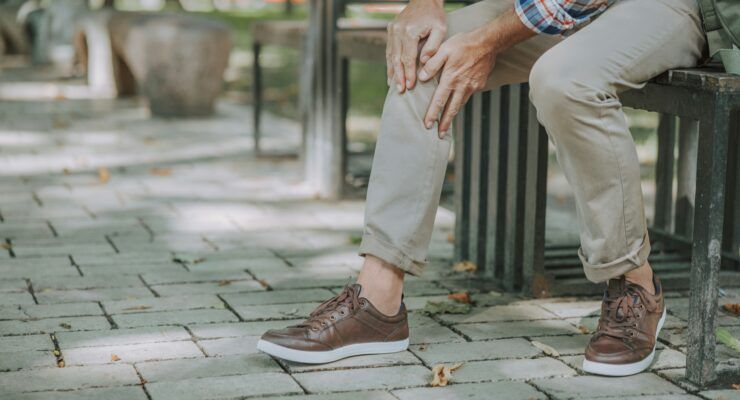
If your knees groan when you stand up from a chair, you’ve probably blamed the usual suspects — your age, the weather, “just wear and tear.” But one of the biggest culprits has nothing to do with how you move. It’s how you sit.
The position that does the damage
The worst thing for an aging knee isn’t a particular exotic pose. It’s the most ordinary one of all: staying put, unmoving, for hours at a stretch.
Here’s why prolonged stillness is so hard on the joint. Your knee cartilage has no direct blood supply. It stays healthy by absorbing fluid every time you bend and straighten the joint, almost like a sponge soaking and squeezing. Sit motionless for hours and that gentle pumping stops. Fluid pools, the cartilage gets less of what it needs, the muscles that brace the knee go quiet and weaken, and stiffness quietly sets in. By the time you finally rise, that first step feels like the hinge has rusted.
The specific habits that make it worse
A few common sitting habits pile extra strain on top of all that, and they hit harder after 60:
- Sitting cross-legged on the floor or dropping into a deep squat loads the knee in a deeply bent position — fine for a young joint with plenty of cushioning, far less comfortable for one that’s lost some.
- Sinking into a low, soft couch means every time you get up, you have to heave your full weight through the knee to escape it. Repeat that a dozen times a day and it adds up.
- Letting your feet dangle with no support leaves the knee hanging under tension for long stretches, which it doesn’t love.
- Locking out a chair-bound routine — the long morning at the desk, the long afternoon in the recliner, the long evening in front of the TV — without ever breaking it up.
The fix is free (and almost insultingly simple)
You don’t need a gadget or a supplement to protect your knees from this. You need movement, and not much of it.
Break up the stillness. Set a quiet reminder to stand and move for a minute or two every half hour — a lap to the kitchen and back is plenty. The point is to pump that joint fluid and wake the muscles, not to exercise.
Choose chairs you can stand from cleanly, without having to push off your knees with your hands. Firmer, higher seats are kinder to the joint than the deep, soft ones.
Strengthen what supports the knee. Gentle work on the muscles around the joint — the quadriceps in front and the muscles of the hip and thigh — does more to protect your knees than any cushion ever will. A physical therapist can build you a simple routine, and there are good guided programs for older adults if you’d rather start at home.
Your knees aren’t asking you to use them less. They’re asking you to stop holding them still for so long. Give them a little motion through the day, and that dreaded first step out of the chair gets a whole lot easier.